High School Students Drafted a National AI Policy for Schools. It Puts Adult Versions to Shame.
98 teenagers from all 50 states gathered in Boston to draft the STUDENTS FIRST Act, a highly specific, mature AI policy framework for K-12 schools.
Right now, school board meetings across the country sound remarkably similar. Administrators worry about cheating. Teachers worry about grading. Parents worry about screen time and data privacy. Everyone is talking about how artificial intelligence will affect education, but almost no one is asking the people who actually sit at the desks.
Students are the primary users of educational technology, yet they are routinely left out of the policy conversations that govern their daily lives. While adults debate whether to ban chatbots entirely or buy expensive enterprise software, teenagers are already using these tools to untangle tricky math concepts, brainstorm debate topics, or take shortcuts on their essays.
The disconnect is obvious. We cannot regulate a tool effectively if we do not understand how it is being used on the ground. When school districts write policies in a vacuum, they often end up with rules that are either impossible to enforce or so restrictive that they block meaningful learning.
But what happens when you hand the pen to the students?
Inside the National AI Student Senate
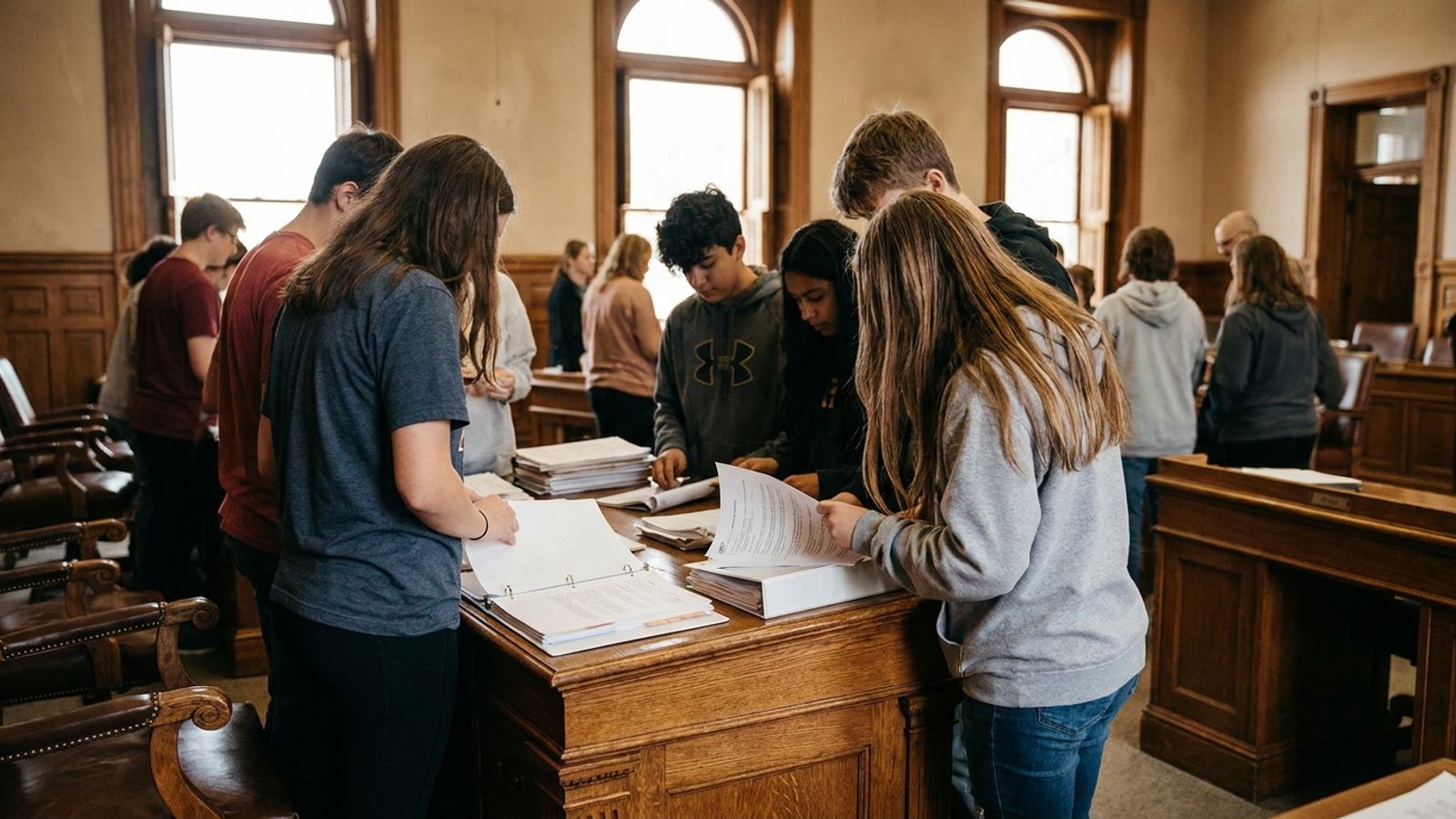
In July 2026, we found out. Over three days at America’s Youth AI Festival, 98 high school students representing all 50 states traveled to Boston. They worked across the UMass Boston and MIT campuses, then took their seats inside a full-scale replica of the United States Senate chamber at the Edward M. Kennedy Institute.
Their goal was ambitious: to draft, debate, and pass a national policy framework for artificial intelligence in K-12 schools. The event was organized by Day of AI, MIT RAISE, the Kennedy Institute, and AASA, The School Superintendents Association.
These teenagers did not just sit through lectures. They divided into subcommittees. They argued over the nuances of data privacy. They weighed the benefits of personalized tutoring against the risks of automated bias. After a weekend of intense debate, they passed the “STUDENTS FIRST Act of 2026” on July 19 by an overwhelming vote of 82 to 16.
“This is written by students, for students,” said Jeff Riley, executive director of Day of AI. “Students from across the country examined the benefits and risks of AI, debated difficult tradeoffs, and developed a serious framework that education leaders can now evaluate, test, and strengthen.”
What they produced is not a vague list of complaints. It is a highly specific, mature piece of model legislation that puts many adult-drafted policies to shame.
What the “STUDENTS FIRST Act” Actually Says
If you want to know what a balanced approach to classroom technology looks like, read the student framework. It avoids the extremes of total prohibition and unregulated access. Instead, it focuses on preserving the core of the learning experience.
Here are the key provisions the students voted for:
A Ban on Original Work Generation The students were clear: using a chatbot to write an essay or generate an art project is not learning. The framework explicitly prohibits students from using artificial intelligence to complete artistic assignments or generate original written work. They understand that the struggle of staring at a blank page, organizing messy thoughts, and finding the right words is a necessary part of cognitive development. Bypassing that struggle deprives students of the chance to discover their own voice.
Permitted Use as a Thought Partner While original generation is banned, the framework recognizes the utility of these programs as a study aid. Starting in the ninth grade, the act allows students to use AI, with explicit teacher permission, for brainstorming, studying, and editing their own writing. This mirrors how professionals use these tools in the workplace. For more on how to strike this balance at home, check out our guide to The Best AI Study Tools for Students in 2026 (and How to Use Them Without Becoming Dependent).
No AI on Graded Assessments The framework draws a hard line at testing. It strictly prohibits the use of AI on any graded assessments, ensuring that grades reflect a student’s actual comprehension and not their prompting skills.
Mandatory Literacy Instruction The students argued that you cannot expect young people to use technology responsibly if you never teach them how it works. The act requires literacy instruction to begin the moment students are first handed digital devices in school. This means teaching younger children about algorithms, data privacy, and the difference between human and machine intelligence. If you are looking for ways to introduce these concepts at home, our manual AI for Students: A Practical, Honest Guide for Teens, Parents, and Teachers is a great place to start.
The Right to Human Judgment
Perhaps the most striking part of the STUDENTS FIRST Act is its intense focus on protecting human relationships and judgment. The students are deeply aware of the flaws in current systems, particularly in automated discipline and grading.
In recent years, many educators have turned to detection software to catch cheaters. The problem is that these detectors are notoriously unreliable. They frequently flag original work as machine-generated, and a Stanford study of widely used GPT detectors found they consistently misclassify writing by non-native English speakers as AI-written.
The toll of a false accusation is real. A student whose honest work gets flagged by a machine can face a failing grade or a disciplinary hearing over something they never did. The student framework tackles this head-on. It gives students the right to appeal any accusation of improper use, mandating that schools provide meaningful human review rather than relying blindly on a software flag. If a student is accused of cheating, the act allows them to demonstrate their mastery of the subject through an oral defense, a handwritten assessment, or an in-person discussion. This simple provision shifts the burden of proof back to human educators and restores trust in the classroom.
Beyond academic integrity, the framework also protects teachers. It prevents schools from using algorithms to independently determine grades, administer discipline, or make hiring decisions. Crucially, it protects the right to opt out. Students can decline to use these tools and ask for an alternative assignment, and educators should not be penalized for choosing not to use AI, as long as they still meet curricular expectations.
It is a principle worth borrowing: the people who use a tool every day belong in the room when the rules for it get written. The teenagers in Boston clearly agree. They want technology to be an option, not an absolute mandate.
Bringing the Policy Home to Your District
The STUDENTS FIRST Act does not have the force of law. It is a framework school systems and state leaders can adapt. In the months ahead, Day of AI, AASA, the Kennedy Institute, and MIT RAISE plan to bring it to school leaders through webinars, workshops, and school visits. AASA alone is a professional community of more than 10,000 educational leaders. For district leaders who have been struggling to draft their own guidelines, this document offers a ready-made, student-approved template.
You do not have to be a superintendent to use this framework. If you are a parent, a teacher, or a community advocate, you can bring these ideas to your local school board.
Start by asking a simple question at your next PTA or school committee meeting: What is our district’s policy on this technology, and how many students helped write it?
If the answer is none, propose a local version of the Boston summit. Gather a diverse group of high schoolers. Give them the STUDENTS FIRST Act as a starting point. Ask them what they think is fair, what they find helpful, and what makes them uncomfortable about technology in their classrooms.
When we treat students as passive consumers of technology, we get policies that feel like punishments. When we invite them to the table as co-authors of their educational experience, we get thoughtful, practical, and highly human solutions. The 98 teenagers who gathered in Boston proved that they are ready to lead. It is time for the rest of us to listen.
Attribution: This story is based on reporting by Education Week and the official announcement from AASA, The School Superintendents Association, on America’s Youth AI Festival, held July 17-19, 2026.